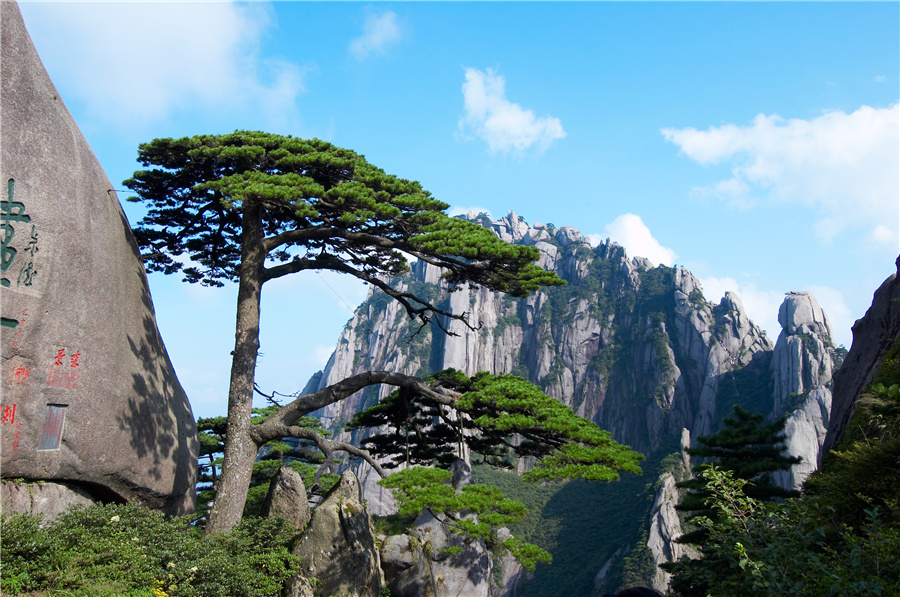
Huangshan Mountain
Overview
Huangshan Mountain, also known as the Yellow Mountain, is located in the southern region of Anhui province in East China. Renowned for its breathtaking natural beauty, Huangshan is celebrated for its imposing peaks, massive granite boulders, ancient pine trees, and the ethereal sea of clouds that often envelops the landscape. These natural wonders, along with its rich cultural heritage, have earned Huangshan a place on UNESCO's World Cultural and Natural Heritage List since 1990. The mountain covers a scenic area of approximately 154 square kilometers and features 72 peaks, with the most notable being Lianhua Peak, Guangming Peak, and Tiandu Peak. Lianhua Peak, also known as Lotus Peak, is the highest point, reaching an altitude of 1,864 meters.
Huangshan's appeal is not limited to its natural wonders; it also boasts a wealth of cultural landmarks, including ancient paths, bridges, pavilions, and stone carvings. These elements have inspired countless literary and artistic works, contributing to the development of the influential Shanshui (mountain and water) school of landscape painting. The mountain's storied past continues to captivate visitors, poets, painters, and photographers who flock to its awe-inspiring vistas.
Natural Heritage
Huangshan Mountain's natural heritage is characterized by its dramatic and diverse landscape, shaped by a complex geological history. The mountain's formation dates back to the Jurassic Period of the Mesozoic Era, with crustal movements and subsequent uplift giving rise to its impressive peaks. During the late Mesozoic and early Cenozoic Eras, granite magma erupted through fissures, cooling to form the main body of the mountain. This geological activity has resulted in a remarkable array of natural formations, including stone pillars, grotesquely-shaped rocks, waterfalls, caves, lakes, and hot springs.
The mountain's ecosystem is well-preserved, with vegetation covering 82.6 percent of the area and forests accounting for 56 percent of the total land. Huangshan is home to approximately 1,450 plant species, including several under protection due to their rarity or endemicity. The dramatic interplay of light and mist further enhances the mountain's natural beauty, with the iconic sea of clouds providing a dynamic backdrop to the rugged landscape.
Cultural Heritage
Huangshan Mountain's cultural heritage is deeply interwoven with its natural beauty, captivating the Chinese imagination since the Tang Dynasty (618-907). The mountain's name, Huangshan, was conferred by imperial order in 747 AD, marking the beginning of its long association with Chinese art and literature. Over the centuries, Huangshan has been a source of inspiration for numerous hermits, poets, and painters, who have celebrated the mountain's scenery through painting and poetry.
During the Yuan Dynasty (1271-1368), 64 temples were constructed on Huangshan, with notable Buddhist monasteries such as Xiangfu Temple, Ciguang Temple, Cuiwei Temple, and Zhibo Temple becoming cultural landmarks. The Ming Dynasty (1368-1644) saw Huangshan become a favored theme for landscape painters, establishing the Shanshui school of art. These cultural contributions highlight the enduring interaction between humanity and nature that defines Huangshan's cultural heritage.
Legends and Stories
Huangshan Mountain is steeped in legends and stories that enrich its cultural significance. Among the most famous is the tale of the Yellow Emperor, the Dragon King, and the Eight Immortals. According to legend, the Yellow Emperor and other immortals once gathered on Huangshan, captivated by its beauty. Stories of their exploits are immortalized in the names of various peaks, such as Xanyuan Peak and Pill-making Peak. Taoist temples were initially established on the mountain, reflecting its mythological associations, but Buddhism later became the predominant religious influence.
Another popular legend is that of the Immortal Showing the Way, where one of the Eight Immortals, Han Xiangzi, was so enthralled by Huangshan's scenery that he created a stone replica of himself to remember the way back. These legends underscore the mountain's mystical charm and its place in Chinese folklore.
Flora and Fauna
Huangshan Mountain boasts a rich diversity of flora and fauna, with its unique ecology supporting a wide range of plant and animal species. The mountain's forests and vegetation cover significant portions of the landscape, providing a habitat for around 1,452 species of native plants. Some of these plants are rare and protected, highlighting the mountain's ecological importance.
The iconic pine trees of Huangshan are a defining feature of the landscape, with their gnarled trunks and umbrella-like canopies often depicted in art and photography. These ancient trees, such as the famous Guest-Greeting Pine, symbolize the warm hospitality of the local people and China's cultural emphasis on etiquette.
In addition to its flora, Huangshan is home to various animal species, including some that are endemic to the region. The mountain's diverse habitats support a range of wildlife, making it a vital area for conservation and ecological research.
Tourism and Cultural Influence
Huangshan Mountain is not only a natural and cultural treasure but also a popular tourist destination. Its stunning landscapes and rich heritage draw visitors from around the world, eager to experience its beauty firsthand. The mountain's influence extends beyond tourism, inspiring artists, writers, and photographers who seek to capture its essence through their work.
Tourism development on Huangshan is guided by a master plan that aims to balance conservation with visitor access. Efforts are underway to preserve the mountain's artistic, cultural, and environmental heritage, ensuring that future generations can continue to appreciate its wonders. The site remains a pilgrimage destination for those seeking inspiration and a deeper connection with nature and history. Article reference1. The peak of imagination. chinadaily.com.cn. 20222. World Cultural and Natural Heritage site in China: Huangshan Mountain. en.chinaculture.org. 20223. Breathtaking rime-covered scenery in E China. chinadaily.com.cn. 2018Photo Gallery(43 pictures)CategoriesTourismTagWorld HeritageWorld Heritage in ChinaNatural WonderRelatedLongchuan Senic Area, XuanchengHan XiangziHuangshan Mountain Hot SpringLiu HaisuCatalogue1. Overview2. Natural Heritage3. Cultural Heritage4. Legends and Stories5. Flora and Fauna6. Tourism and Cultural Influence- - - []








